
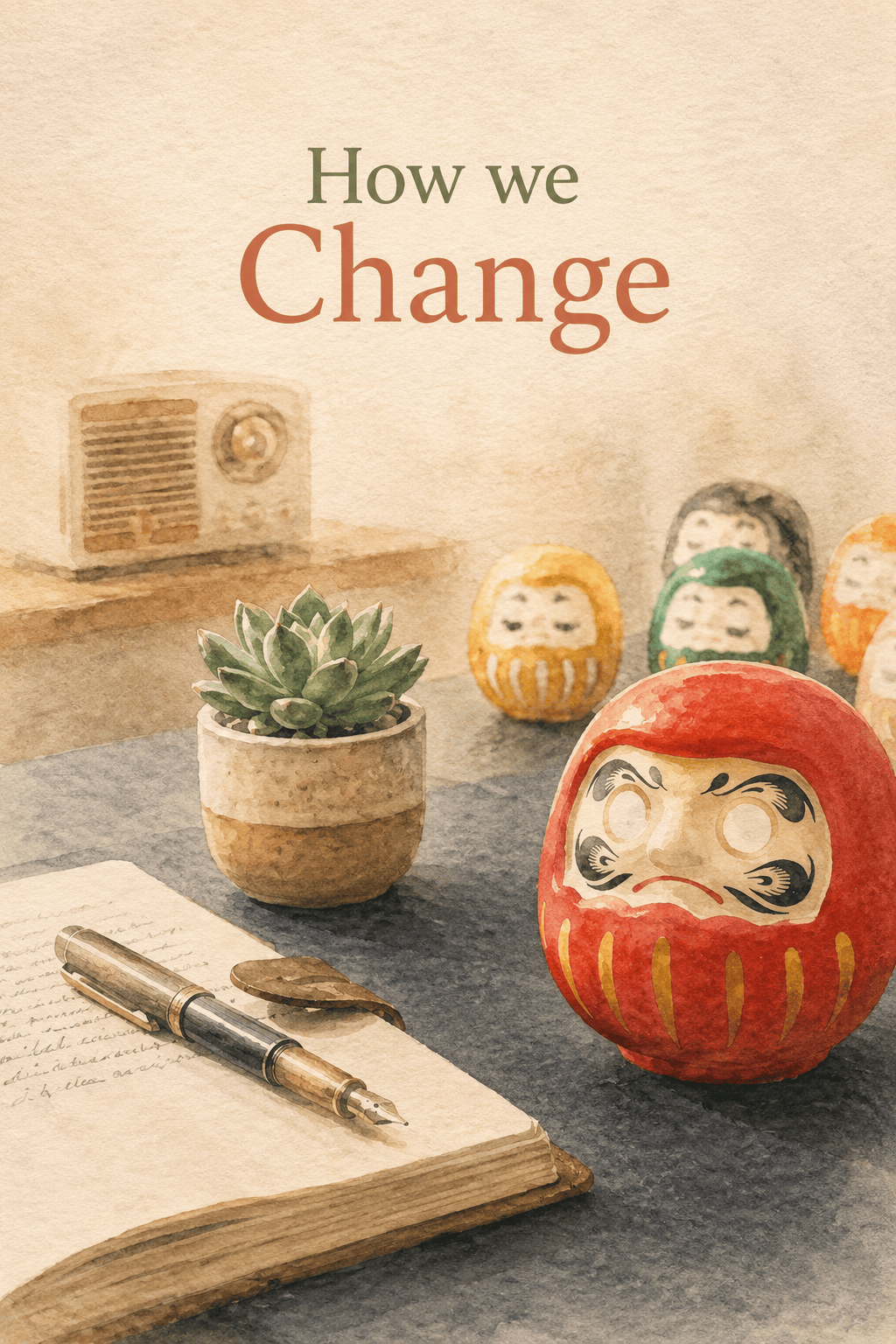
What habit science — and a Japanese doll — can teach us about lasting growth
Imagine that tomorrow morning you wake up and decide to change something. A new habit. A new mindset. A new version of yourself.
How would you begin? And more importantly, how would you keep going once the first burst of motivation fades?
These are questions people bring into the counselling room again and again. They rarely arrive as questions about willpower. More often they sound like: I know what I want to do. I just can't seem to keep doing it.
It's worth understanding why that happens — because a great deal of what we do each day isn't decided in the moment at all. Researchers estimate that a substantial portion of daily behaviour, by some measures close to half, runs on habit rather than deliberate choice. Which means changing a life often has less to do with grand decisions and more to do with the small, repeated patterns underneath them.
Libraries are full of books on this subject. Stephen Covey's The 7 Habits of Highly Effective People has sold tens of millions of copies. Psychology and neuroscience journals are thick with studies on behaviour change. And across all these different approaches, a few consistent themes emerge.
1. Every habit has three parts, not one
A habit isn't just a behaviour. It begins with a cue — something that triggers or reminds you to act. Then comes the behaviour itself. Then the reward.
Most people trying to change focus entirely on the middle part: the ritual, the discipline, the doing. But in The Power of Habit, Charles Duhigg describes what he calls the golden rule of habit change — work with the cue and the reward, not just the behaviour sitting between them.
This matters practically. Research on exercise adherence suggests that people who pair a new routine with a small, immediate reward tend to stay consistent longer than those relying on the distant promise of future benefit. The brain learns from what happens now, not from what we've told it will happen in six months.
So it's worth asking: what reliably triggers the behaviour you want? And what does the behaviour actually give you, right away?
2. Start smaller than feels reasonable
It's no accident that Atomic Habits by James Clear and Tiny Habits by BJ Fogg have resonated with so many readers. Their shared insight is that change doesn't begin with motivation. It begins with making the first step so small that motivation becomes almost unnecessary.
If the goal is to start going to the gym, the first version of that habit might be: go to the gym, stay five minutes, go home. That's it.
As the saying goes, the heaviest weight in the gym is the front door.
This feels counterintuitive, even a little embarrassing. But the point of a small habit isn't the workout. It's establishing the identity and the pattern — proving to yourself that this is something you do.
3. Repetition takes longer than anyone wants it to
The aim of habit formation is automaticity: the point at which a behaviour requires little conscious effort. Getting there takes time, and considerably more of it than the popular "21 days" claim suggests.
One well-known study following people forming new habits found enormous variation between individuals — automaticity emerged anywhere from around eighteen days to well over two hundred, depending on the person and the complexity of the behaviour. The median sat closer to two months.
There is something quietly freeing in that range. If your new habit hasn't stuck after three weeks, you are not failing. You are simply somewhere inside a normal timeline.
The part the frameworks don't quite capture
And yet — anyone who has genuinely tried to change themselves knows that cues, rewards, small steps and repetition don't tell the whole story.
Consider the Daruma doll.
The Daruma is a round, hollow figure from Japan, traditionally used to hold an intention. The custom is simple: when you set a goal, you paint in one eye. When you achieve it, you paint in the second. In between, the doll sits somewhere visible, watching you with one eye, waiting.
It's a beautiful practice. It is also, for many people, a difficult one — because a visible reminder of an unmet goal doesn't always inspire. Sometimes it accuses. A one-eyed doll on the kitchen shelf can quietly become a daily notice of everything not yet done, until the easiest response is to stop looking at it altogether.
And then, sometimes, months later, something shifts. Not because of a new system or a fresh surge of discipline. The change simply begins to move, often long after the reminder has been forgotten.
It helps to think of an intention as a seed.
When you plant a seed, the soil looks exactly as it did before. Nothing appears to be happening. There is no green, no stem, no evidence of any kind — and if you judged the seed only by what you could see, you would conclude it had failed. But underground, in the dark, the roots are already forming. That growth is real, and it comes first. It has to. Nothing can rise above the surface until something is holding it there.
An intention held in the unconscious mind works the same way. In those quiet months when nothing seems to be changing, roots are going down. When something is genuinely aligned with who we are — rather than who we think we should be — some part of us begins to take root around it, and slowly starts noticing openings, options and pathways that were always present but previously invisible. Then one day there is a shoot, and it seems to have appeared out of nowhere.
It didn't. It was being built the whole time, out of sight.
This is also why shame is such a poor engine for growth. Standing over the soil demanding to see progress does nothing for the roots. It can produce a short sprint. It rarely produces a life.
The other lesson in the doll
There's a second thing worth knowing about the Daruma. It's weighted at the base. Push it over, and it rights itself. Knock it down again, and it comes back up.
That may be the truest thing about change.
It doesn't matter especially how long it takes. It doesn't matter how many times old patterns reassert themselves — and they will, usually at the least convenient moment. What matters is the returning.
Change is not about perfection. It is about coming back. Again, and again, until the new version of yourself is no longer a project but simply who you are.
So if there's one idea worth holding onto, it's this: don't measure change only by its speed. Measure it by your willingness to rise each time you fall.
Lasting transformation is rarely built in a single dramatic moment. It's built in the quiet decision to get back up.
If you're working towards a change that keeps slipping out of reach, counselling can offer a space to understand what's underneath the pattern — and to build something that lasts. Get in touch with Mend and Grow.