
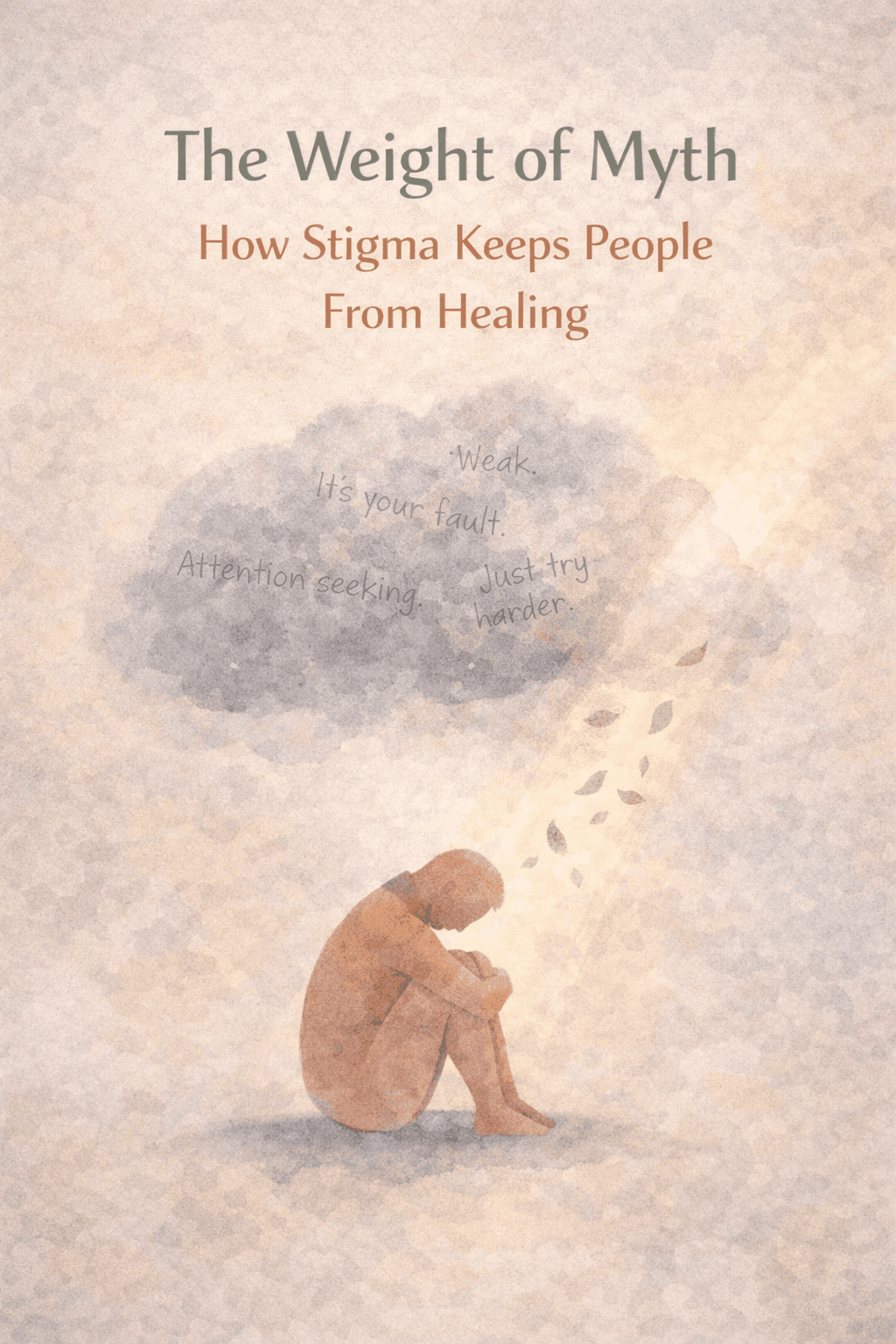
When we believe false things about addiction, we don't just misunderstand a disease, we build walls around the people who need help most. The myths surrounding substance use disorder aren't harmless misconceptions. They calcify into stigma, and stigma kills. It kills by making people feel unworthy of care. It kills by turning treatment into an admission of weakness rather than an act of courage. And it kills by setting expectations so impossibly high that the first stumble feels like the final proof that recovery was never meant for them.
From Myth to Stigma: The Direct Line
Every myth about addiction carries a moral judgment hidden inside it. When we say addiction is "completely a choice, " we're really saying the person chose to be this way, and therefore deserves their suffering. When we say treatment doesn't work, we're really saying these people aren't worth investing in. When we wait for someone to "hit bottom, " we're really saying they need to earn our help first.
This is the machinery of stigma. It converts a complex health condition into a character indictment, and it does so quietly, often without anyone realising that's what's happening. People absorb these messages from their families, their communities, their workplaces, and even their healthcare providers. By the time someone is struggling with SUD and wondering whether to reach out for help, they have often already internalised the verdict:
This is my fault, and I should be able to fix it myself.
Stigma is one of the most consistently cited barriers to treatment-seeking across every population studied. People don't avoid help because they don't want to get better. They avoid it because asking for help means confirming what they fear everyone already thinks about them, that they are weak, broken, or morally deficient.
The Moral Failure Trap
Perhaps the most corrosive consequence of addiction mythology is the way it frames SUD as a moral failure rather than a health condition. This framing is devastating in a very specific way: it doesn't just discourage people from seeking treatment, it makes them set punishing standards for themselves once they do.
If addiction is about willpower, then recovery must be about willpower too. Which means any slip, any struggle, any day that doesn't go according to plan becomes evidence of personal inadequacy rather than the expected course of a complex illness. People enter treatment expecting a linear march toward sobriety, and when the reality proves messier than that, as it almost always does, they conclude that they have failed, that they are beyond help, and that they might as well stop trying.
This is what myths cost us in human terms. Not just delayed treatment, but people abandoning recovery entirely because the story they were given about what healing should look like bore no resemblance to their actual experience.
SUD Is Complex, So Is Healing From It
Here's what the evidence tells us: substance use disorder is not one thing. It is a constellation of biological, psychological, social, and environmental factors that combine differently in every single person. Genetics load the gun, but trauma, poverty, mental illness, loneliness, and lack of opportunity can all pull the trigger. And because the roots of SUD are different for each person, the path through it must be different too.
A one-size-fits-all approach to treatment isn't just ineffective, it's a logical mismatch.
Offering the same intervention to every person with SUD is a bit like treating every broken bone with the same cast regardless of which bone, how it broke, or what the person's overall health looks like. Effective treatment has to account for the full person:
- Their history and circumstances
- Co-occurring mental health needs
- Cultural context and personal values
- Their own goals for recovery
Medication-assisted treatment is transformative for some people and not the right fit for others. Residential programs work well for some and create barriers for people with jobs or children. Peer support, therapy, harm reduction, family involvement, all of these have roles to play, and the art of good treatment is in the combination and the timing.
Recognising complexity isn't pessimistic. It's actually the most hopeful thing we can do, because it means there is no single door that a person has to fit through in order to deserve healing.
We Are Built to Heal
One of the most important, and most overlooked, truths about addiction recovery is that the capacity for healing is already inside every person who struggles with SUD. We don't talk about this nearly enough, because the mythology around addiction has us focused on brokenness rather than resilience.
Think about what happens when you cut your finger. You don't have to instruct your body to heal. You don't have to earn the right to heal or demonstrate sufficient remorse about getting cut in the first place. The biological process of repair begins automatically, because healing is what living systems do. Your role is simply to create the conditions that support it, keep it clean, protect it from further injury, give it time.
Recovery from SUD works on the same principle. The brain is profoundly neuroplastic, capable of restructuring itself in response to new experiences, relationships, and environments. People recover from addiction every single day, not because they were exceptional, but because they were human, and humans are built for adaptation and healing.
What makes the difference, more often than not, is not the strength of the individual's willpower but the quality of the environment surrounding them. Safety, connection, access to care, freedom from ongoing trauma, meaningful purpose, these are the conditions that allow the innate healing process to unfold.
Our job as a society is not to decide who deserves to heal. It is to build the environments that make healing possible.
Chronic, Relapsing, and Still Worth Fighting For
SUD is formally defined as a chronic, relapsing disorder, and this is not a concession of defeat. It is a clinical reality that changes everything about how we should understand the recovery process.
Chronic means it unfolds over time, with periods of stability and periods of difficulty, just like diabetes, asthma, or heart disease. We do not tell a person with hypertension that their blood pressure rising again means treatment has failed and they should give up. We adjust. We try something different. We remain in it with them.
Relapsing means that returning to use after a period of abstinence or stability is a predictable feature of the condition, not a verdict on the person's character or commitment. Research consistently shows that most people who eventually achieve sustained recovery do so after multiple treatment attempts. That is not failure accumulating, it is the normal, non-linear path of recovery from a complex chronic illness.
This reframing matters enormously for how people relate to their own experience. When someone understands that needing another attempt at treatment is part of the expected course of SUD, rather than proof that they are hopeless, they are far more likely to try again. And trying again is where recovery lives.
The number of attempts is not the story. The continuing to try is the story.
Unrealistic Expectations: The Hidden Cost of Mythology
Myths don't just stop people from seeking help, they shape what people expect from help once they find it. And when expectations are built on mythology rather than reality, they set people up to interpret the natural course of recovery as personal failure.
Someone who enters treatment believing that a single program should produce permanent sobriety will experience their first difficult period as confirmation that they are beyond saving. Someone who believes that struggling after completing treatment means they didn't try hard enough will carry shame that makes returning to care feel impossible. Someone who has been told they should be able to do this alone will resist the peer connection and professional support that research consistently shows are central to sustained recovery.
Realistic expectations, that recovery is non-linear, that setbacks are part of the process, that needing help is not weakness, are not lowered expectations. They are honest ones. And honesty, it turns out, is one of the most therapeutic things we can offer a person trying to heal.
What We Owe Each Other
Dismantling the myths around addiction is not an abstract exercise in being nice. It is a matter of life and death. When we replace moral judgment with scientific understanding, when we stop demanding that people heal on our timeline and in our preferred way, when we commit to creating environments that support recovery rather than environments that punish struggle, we save lives.
The path forward requires all of us:
- Individuals, examining the assumptions we carry about addiction and the people affected by it
- Families, learning to offer support without conditions tied to a particular version of recovery
- Healthcare providers, screening for and actively working to reduce stigmatising language and practice
- Communities, building systems of care that are accessible, flexible, and grounded in evidence
- Policymakers, shifting resources from punishment toward treatment, harm reduction, and prevention
People with SUD are not failed people. They are people whose healing has been made harder than it needs to be by the world around them.
And that is something all of us have the power to change.
This article is part of a series on addiction, stigma, and the science of recovery.