
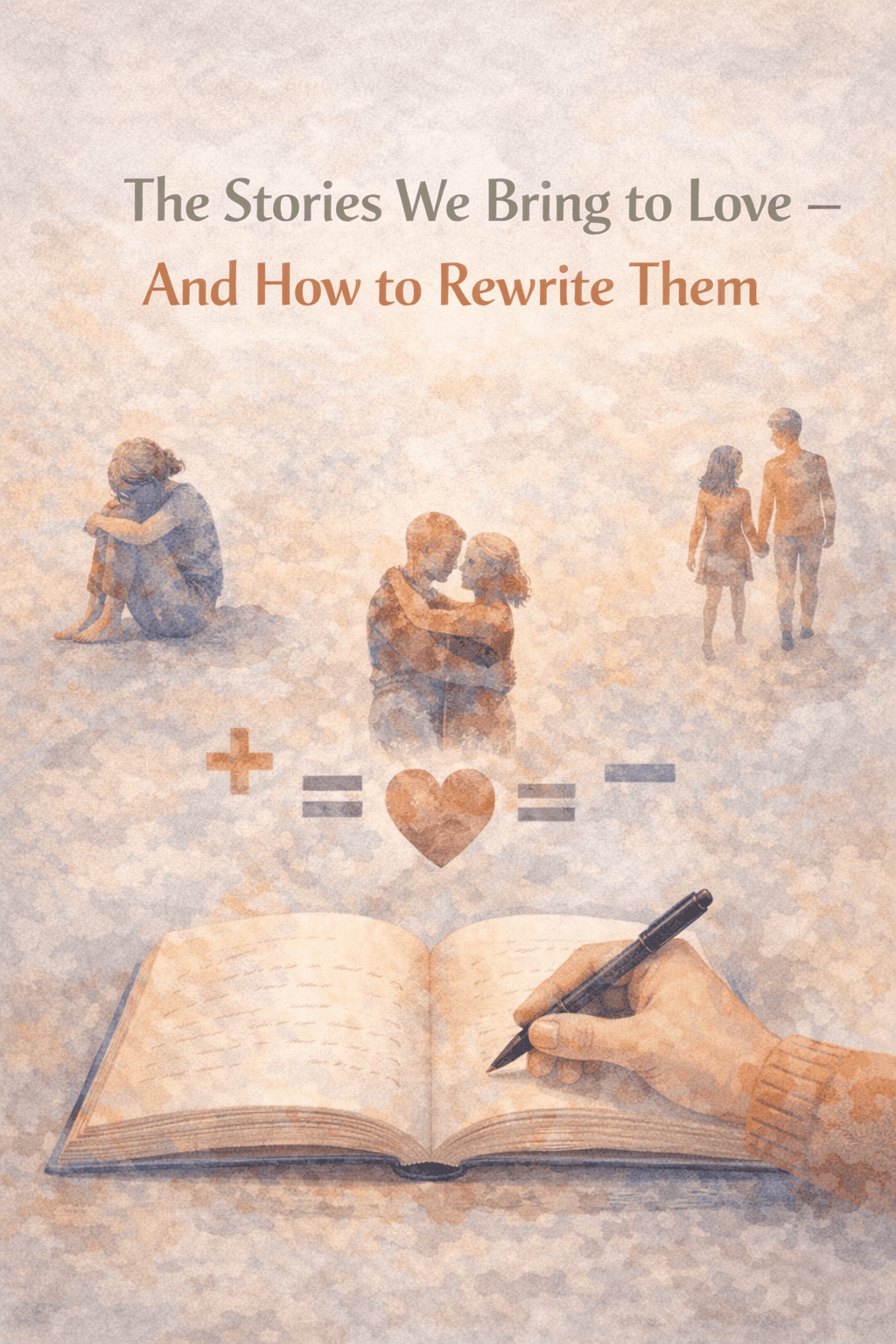
Most of us walk into relationships carrying a suitcase we didn't consciously pack.
Inside are the stories we learned about love, from watching our parents argue or go quiet, from the first heartbreak that taught us something was wrong with us, from the relationships that ended and the ones that didn't. We carry ideas about what we deserve, what intimacy is supposed to feel like, and what another person's distance or closeness means about our own worth.
The trouble is, we usually don't know the suitcase is there. We think we're responding to our partner. We're often responding to something much older.
The Patterns We Repeat Without Realising It
Lori Gottlieb, psychotherapist and author of Maybe You Should Talk to Someone, puts it plainly: we all have a list. Sometimes it's written down. More often, it lives in the body, in the gut pull toward certain people, the inexplicable comfort or discomfort we feel in the first weeks of a relationship. The trouble is that the list is often assembled not from genuine self-knowledge but from old wounds.
We choose partners who help us replay unfinished business. Or we overcorrect, picking someone who seems like the opposite of the person who hurt us, only to discover, months or years later, that the dynamic feels strangely familiar. The faces change. The feeling doesn't.
What Gottlieb's work asks of people is not just to understand this intellectually, most of us have heard some version of it, but to catch it happening in real time. Knowing that you tend to go cold when you're scared is very different from noticing yourself going cold right now and choosing to do something different. The gap between insight and action is where most relationship work actually lives.
Why We Do It: The Science of Attachment
The patterns Gottlieb describes in the therapy room have a well-established neurological explanation. Attachment theory, first developed by John Bowlby and later expanded by Mary Ainsworth, holds that the bonds formed with our earliest caregivers create internal templates, working models, that quietly guide how we behave in intimate relationships decades later.
Research consistently shows that adults carry one of several broad attachment orientations into romantic life. Securely attached individuals tend to be comfortable with closeness, able to communicate their needs, and generally willing to give partners the benefit of the doubt when things get hard. Anxiously attached individuals crave intimacy but are hypervigilant to signs of rejection. Avoidantly attached individuals equate closeness with a loss of independence and tend to withdraw precisely when vulnerability is most needed.
A 2023 study confirmed what therapists have observed for decades: people with insecure attachment report lower psychological well-being, lower self-esteem, and significantly higher cortisol levels during relational stress. Avoidant individuals specifically showed higher autonomic nervous system activity and poorer immune function, meaning the emotional cost of keeping people at arm's length has a measurable physical price.
Perhaps the most important finding in recent attachment research is also the most hopeful: these styles are not destiny. Neuroplasticity means that what was learned can be, with enough effort and the right conditions, unlearned. Secure attachment can be developed in adulthood, both through therapy and through relationships that consistently provide safety, responsiveness, and repair after rupture.
This is why Bessel van der Kolk, author of The Body Keeps the Score, frames early emotional experience in such stark terms: "How loved you felt as a child is a great predictor of how you manage all kinds of difficult situations in life." Not a minor influence. A predictor.
The Stories We Tell About Emotion
There's another layer beneath the attachment patterns. Many of us were simply never taught to access our own feelings.
Think about how most of us learned to handle difficult emotions as children. A parent might have said "you're fine" when we weren't. Or changed the subject. Or told us what to do before we'd even finished describing how we felt. The message, absorbed wordlessly, was: feelings are inconvenient, manage them fast, or don't have them at all.
So instead of saying "I'm scared, " we pick a fight. Instead of saying "I need reassurance, " we go cold and wait to see if our partner notices. Instead of saying "this is hard for me, " we make it about something concrete, the dishes, the schedule, because concrete things feel safer to talk about than the vulnerability underneath.
The feeling is always there. We just haven't learned to translate it into something another person can actually receive.
You Can't Love Someone À La Carte
One of Gottlieb's sharpest observations is also one of the most confronting: we don't get to select only the parts of a partner that please us and quietly return the rest.
Research on decision-making supports a counterintuitive conclusion: people who approach major choices with exhaustive lists of criteria consistently report less satisfaction with what they choose than people who find something good enough and commit to it fully. The maximiser's curse applies to love, too.
What sustaining a real relationship requires is the capacity to hold complexity. To stay curious about someone even when they're frustrating you. To resist the urge to edit your partner into a more convenient version of themselves. To understand that the trait that drives you crazy is often connected, in some deep way, to the trait you fell in love with.
This doesn't mean accepting genuinely harmful behaviour. It means accepting that real love is not a finished product, it's a practice, and the person you're practising it with is also, always, a work in progress.
Starting the Rewrite
None of this is comfortable work. But it is available work, to anyone willing to look honestly at what they've carried in. A few places to begin:
Get curious about your patterns, not just your partner's. The conflicts that keep recurring, the emotional reactions that feel bigger than the moment warrants, these are entry points into your own story, not indictments.
Notice the gap between what you feel and what you say. If you're upset because you're scared, say you're scared. The directness will feel exposing. It will also land completely differently than the argument it was masking.
Give yourself time with your reactions. The instinct that fires first in a conflict is often the part of you that learned to cope before it learned to connect. You don't have to act on it. You can pause, breathe, and ask what your Wise Adult would do instead.
The goal isn't to become a perfectly self-aware, endlessly patient partner. The goal is to become a little more honest, a little more curious, and a little more willing to see yourself clearly, in the moments when it's hardest.
Next in this series: "The Courage of Accountability", why owning your mistakes is one of the most intimate things you can do.